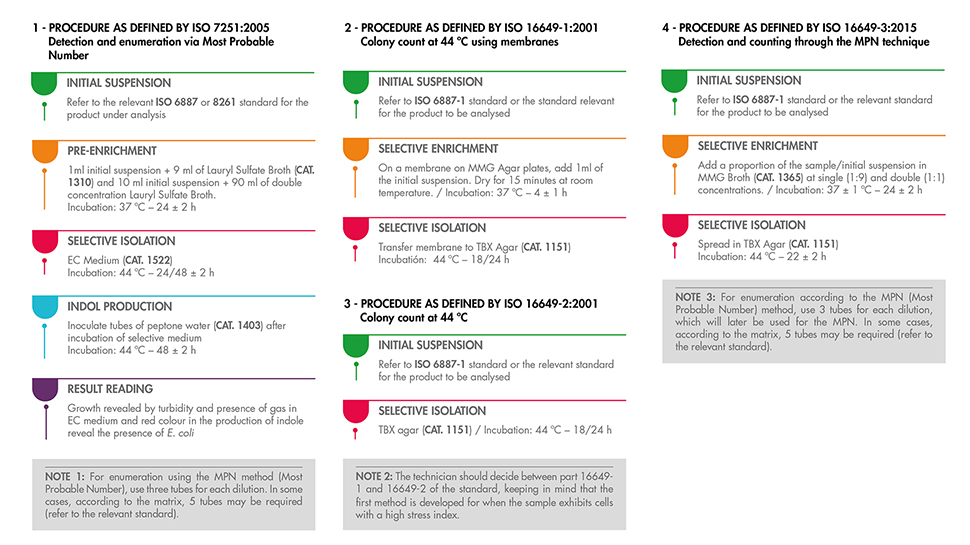
ISO Regulations: how to detect and enumerate E. coli with a chromogenic
This refers to a microorganism belonging to the Enterobacteriaceae family. It is a gram-negative, motile,
non-sporulating bacillus. Additionally, it is lactose positive and oxidase negative. Escherichia coli can be distinguished from other coliforms by its ability to produce indole from tryptophan or by its production of the ß-glucuronidase enzyme.
These characteristics are used for selective isolation and the confirmation of different analytic processes as we will describe next. Additionally, these bacteria are found in the intestines of humans and warm-blooded animals. Due to their high presence in the intestinal tract and faeces, they are considered a marker microorganism of bad hygienic practices or fecal contamination during the handling of food.
Procedure